A number of patients have started calling ahead of their Sofwave appointments asking about a different device: Xerf. Some saw it on social media, others read about its FDA clearance in the aesthetics press, and a few noticed it being offered at other NYC med spas. It’s turned into a real Sofwave vs. Xerf question, and it deserves a straight answer.
Both Sofwave and Xerf are FDA-cleared, non-invasive treatments designed to tighten skin without surgery or downtime. But they’re built on different technology, cleared through different regulatory paths, and backed by very different amounts of published evidence. Here’s what actually separates them in the Sofwave vs. Xerf comparison, and why Aion Aesthetics has built its skin-tightening program around Sofwave.
What Is Xerf?
Xerf™ is a monopolar radiofrequency (RF) device made by Cynosure Lutronic, the aesthetic device company formed when Cynosure and Lutronic merged in April 2024. The FDA cleared Xerf on August 11, 2025 (publicly announced August 18, 2025), making it one of the newest skin-tightening devices on the U.S. market.
Xerf delivers two RF frequencies, 2 MHz and 6.78 MHz, through a handpiece with interchangeable tips, heating tissue to encourage collagen contraction and remodeling. Because it’s a monopolar device, treatment requires a grounding return pad attached to the patient, similar to electrosurgical equipment used in general surgery. Cynosure Lutronic markets Xerf as needle-free and downtime-free, with sessions that don’t require topical numbing.
What Is Sofwave?
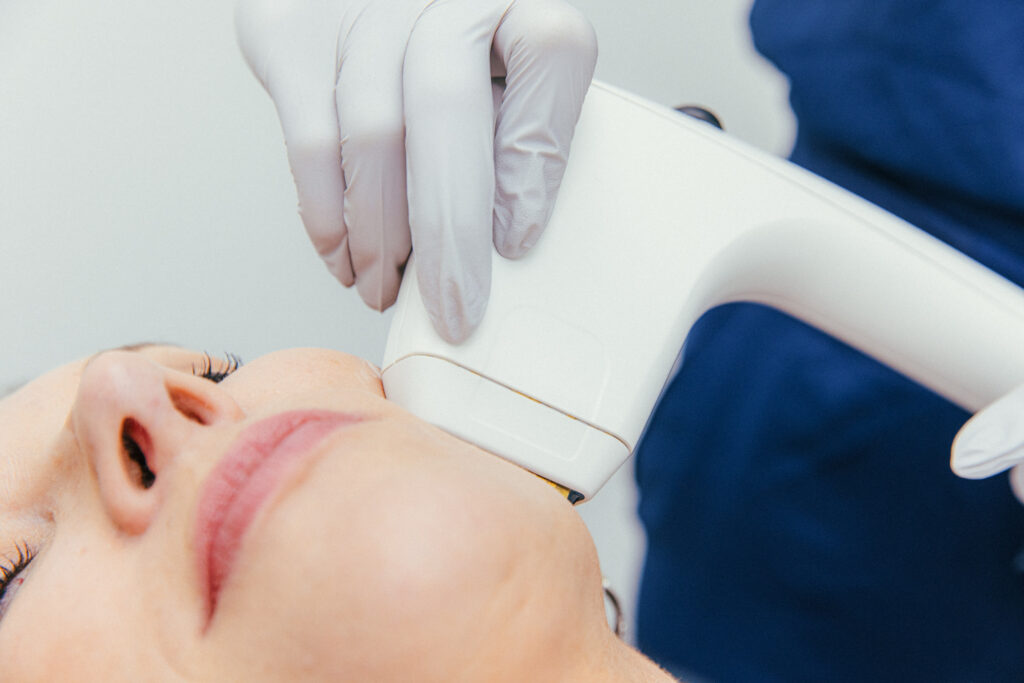
Sofwave™ uses a different approach: Synchronous Ultrasound Parallel Beam technology, or SUPERB™, developed by Sofwave Medical Ltd. Instead of radiofrequency, Sofwave delivers ultrasound energy in parallel beams that converge at a fixed depth in the mid-dermis, the layer where collagen and elastin production begins, while a cooling mechanism protects the skin’s surface during treatment.
Sofwave first received FDA clearance in September 2019 for lifting the eyebrow, submental (under-chin) area, and neck, and for improving the appearance of facial lines and wrinkles in patients 22 and older. Since then, the FDA has cleared it for additional indications: short-term improvement in the appearance of cellulite, treatment of acne scars (2023), and improvement of skin laxity on the upper arms. At Aion Aesthetics, Dr. Akis uses Sofwave to address early jawline softening, fine lines, and uneven texture, typically in 45- to 90-minute sessions.
Sofwave vs Xerf: The Core Technical Difference (Ultrasound vs. Radiofrequency)
The underlying technology matters. It determines how precisely energy reaches its target layer.
Sofwave’s parallel ultrasound beams converge at a consistent depth in the mid-dermis, delivering a controlled dose of heat to that specific layer while a cooling plate protects the surface. Xerf, like other monopolar RF devices, heats tissue more broadly. Depth and intensity depend on the operator’s tip selection, power setting, and technique, with energy traveling from the treatment tip through the body to a grounding pad.
Neither approach is automatically “better” in the abstract. Ultrasound devices like Sofwave generally offer more consistent, targeted depth control. RF devices like Xerf can treat a larger area per pass, and Xerf’s dual-frequency design lets it address more than one depth in a single pass. The right choice depends on anatomy, goals, and what the evidence actually shows for each specific device, which is where this comparison gets more useful.
What Sofwave’s Evidence Shows
This is the part patients rarely hear, and it’s worth spelling out plainly.
Every one of Sofwave’s FDA clearances rests on a dedicated clinical study. The 2023 acne scar clearance drew on a multicenter trial of 67 patients across four U.S. sites. Three treatment sessions produced improvement in 97% of patients, as judged by masked evaluators, with no serious or unanticipated adverse events.
A more recent multicenter study, published in the Journal of Cosmetic Dermatology (2025), followed 60 women treated on the thighs and buttocks with Sofwave’s LiftHD high-density handpiece. Blinded assessors found improvement in 91% of treated areas. Cellulite severity dropped by an average of 69%, laxity scores improved 53% at the three-month mark, and 73% of patients reported satisfaction with their results.
What Xerf’s Evidence Shows
Xerf’s most recent FDA submission tells a different story, and this isn’t opinion, it’s what Cynosure Lutronic’s own 510(k) filing says. The clearance summary submitted to the FDA (K251327) states plainly, under the section for clinical testing: “No clinical tests were included as part of this submission.”
Clearance instead rested on non-clinical bench and ex-vivo testing, including a study showing Xerf’s thermal performance was “equivalent” to that of Thermage FLX, the predicate device Cynosure Lutronic used to establish substantial equivalence under the FDA’s 510(k) pathway. Regulators also framed Xerf’s official indication for use in general electrosurgical terms, “electrocoagulation and hemostasis” under 21 CFR 878.4400, the same classification and product code used for its predicate.
To be clear, none of this means Xerf doesn’t work or is unsafe. The 510(k) pathway exists so manufacturers can bring a new device to market by showing it performs comparably to an already-cleared predicate, without repeating clinical trials from scratch. It’s a legitimate, common route for energy-based devices, and RF skin tightening has a long track record as a category: providers have used Thermage, Xerf’s predicate, since the early 2000s. Cynosure Lutronic has registered a company-sponsored study evaluating Xerf’s safety and efficacy for aesthetic use in the federal clinical trials registry, but as of this writing, that study hasn’t published results.
Sofwave’s specific claims, faster acne scar improvement, measurable cellulite reduction, laxity improvement, each rest on published human clinical data of their own. Xerf’s most recent clearance leaned on bench testing and comparison to an existing device instead. Neither fact predicts how either device will perform on your skin, but it’s exactly the kind of information a patient asking “should I try Xerf instead of Sofwave” deserves before booking.
Sofwave vs Xerf Track Record: Six Years vs. Six Months
Sofwave has carried FDA clearance and seen clinical use since 2019, giving it more than six years of real-world use, multiple separate FDA clearances, and a growing body of peer-reviewed publications across several treatment indications.
The FDA cleared Xerf in August 2025, and its U.S. commercial rollout only began that September. It’s simply too early for the kind of longitudinal, independent, real-world outcome data that now exists for Sofwave. That gap will likely close as Xerf accumulates more time on the market and its registered clinical trial reports results, but as of today, it hasn’t yet.
Who’s a Good Candidate for Sofwave?
Based on its FDA-cleared indications, Sofwave generally suits adults with:
- Mild to moderate skin laxity around the jawline, brow, or neck
- Fine lines and wrinkles related to collagen loss
- Uneven skin texture, including some acne scarring
- Skin laxity on the upper arms
- Cellulite on the thighs or buttocks, including changes some patients notice after rapid weight loss
That last point has become more relevant as more patients pursue GLP-1-supported weight loss and notice looser skin and more visible cellulite afterward. If that’s part of your picture, it’s worth discussing alongside a broader plan, including Aion’s medically supervised weight loss program, during a consultation.
Candidacy for any energy-based device depends on individual anatomy, skin type, medical history, and goals. A qualified provider should evaluate all of these factors before recommending treatment, regardless of which device is under consideration. Not every Sofwave indication or handpiece is available at every location, so ask during your consultation which applications apply to you. This is not a comprehensive candidate list, and it isn’t a substitute for an in-person evaluation.
Aion Aesthetics’ Perspective
Patients ask us about new devices constantly, and we think that’s a good thing. Doing your homework before committing to a treatment is exactly the kind of engagement we want to see.
We built our skin-tightening program around Sofwave because of the depth precision of its ultrasound technology, and because a dedicated, published clinical study backs each of its FDA clearances, not because it’s the only device on the market. If Xerf, or any other new technology, builds a stronger independent evidence base over time, we’ll evaluate it the same way we evaluate everything: on the data, not the marketing.
In the meantime, Dr. Akis pairs Sofwave with a DNP-directed lift plan tailored to your anatomy, whether that’s the jawline, brows, neck, or upper arms, and layers in complementary treatments like Botox or PDO smooth threads when it fits your goals.
Sofwave vs Xerf: Final Takeaway
In the Sofwave vs. Xerf comparison, both are legitimate, FDA-cleared approaches to non-surgical skin tightening, but they’re not interchangeable and they’re not equally studied. Sofwave’s ultrasound technology carries more than six years of FDA clearances, and each one rests on its own published clinical trial. Xerf is a newer RF device whose most recent clearance relied on bench testing and comparison to an existing predicate device rather than new human studies of its own.
If you’re weighing Xerf against Sofwave, or just trying to figure out what’s right for your skin, the most useful next step isn’t more searching, it’s a proper evaluation. Schedule a consultation at Aion Aesthetics on the Upper East Side or in NoMad, and we’ll walk you through what the evidence actually supports for your goals.
Frequently Asked Questions
Sofwave vs. Xerf: Which One Should You Choose?
When people ask about Sofwave vs. Xerf, the honest answer is that “better” depends on what’s being measured. Xerf uses monopolar radiofrequency, and the FDA cleared it in August 2025 based on non-clinical bench testing comparing it to Thermage FLX; the submission included no clinical trial data. Sofwave uses ultrasound technology and has carried multiple FDA clearances since 2019, and each one rests on its own published clinical study. Sofwave currently has substantially more independent, published clinical evidence behind its specific claims. This isn’t a claim that Xerf doesn’t work, RF skin tightening is a well-established category, but individual results vary by patient, provider skill, and device regardless.
What is Xerf, exactly?
Xerf is a monopolar radiofrequency skin-tightening device made by Cynosure Lutronic. It delivers dual-frequency RF energy (2 MHz and 6.78 MHz) through a handpiece and requires a grounding return pad, similar to other monopolar RF devices. The FDA cleared it on August 11, 2025.
Does Aion Aesthetics offer Xerf?
No. Aion Aesthetics offers Sofwave for non-surgical skin tightening. We chose Sofwave for its ultrasound precision and the published clinical evidence supporting each of its FDA-cleared indications.
What does Sofwave treat?
Sofwave is FDA-cleared to lift the eyebrow, submental area, and neck; improve the appearance of facial lines and wrinkles; provide short-term improvement in the appearance of cellulite; treat acne scars; and improve skin laxity on the upper arms.
How long do Sofwave results last?
Most patients see initial changes within one to three weeks, with full results developing over the following three to six months as new collagen forms. Results typically last 12 to 15 months, and many patients repeat treatment annually to maintain them. Individual results vary.
Is Sofwave safe for all skin types?
Sofwave is FDA-cleared, and researchers have studied it across a range of skin types and tones. Because it targets the mid-dermis without disrupting the skin’s surface, it carries a low risk of pigment changes. As with any energy-based treatment, a qualified provider should confirm candidacy based on your health history and treatment area.
This content is for educational purposes only and does not constitute medical advice. Treatment plans vary based on individual assessment by a qualified provider.